

By reopening NATO membership, Slovenia risks reinforcing the Kremlin’s narrative of pre-1997 “borders” and accelerating a new phase of hybrid warfare across Europe.
Apr 22, 2026 | ANALYSIS, NATO, NEWSLETTER, POLITICS
By Xhabir Deralla, CIVIL-Center for Freedom
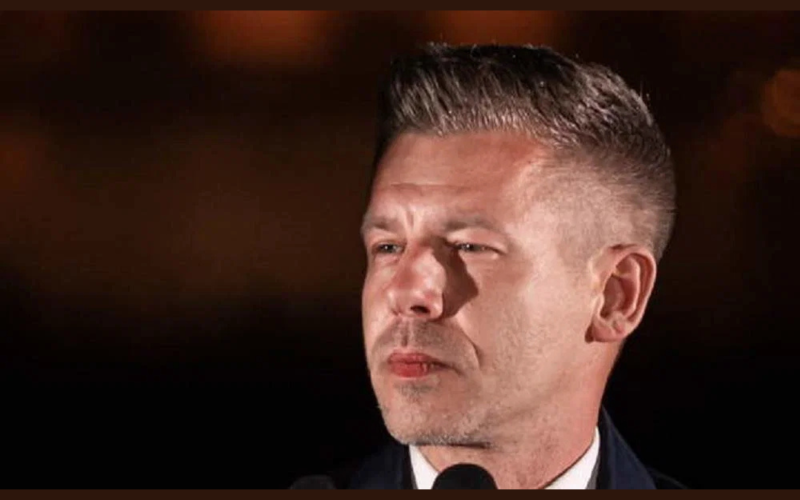
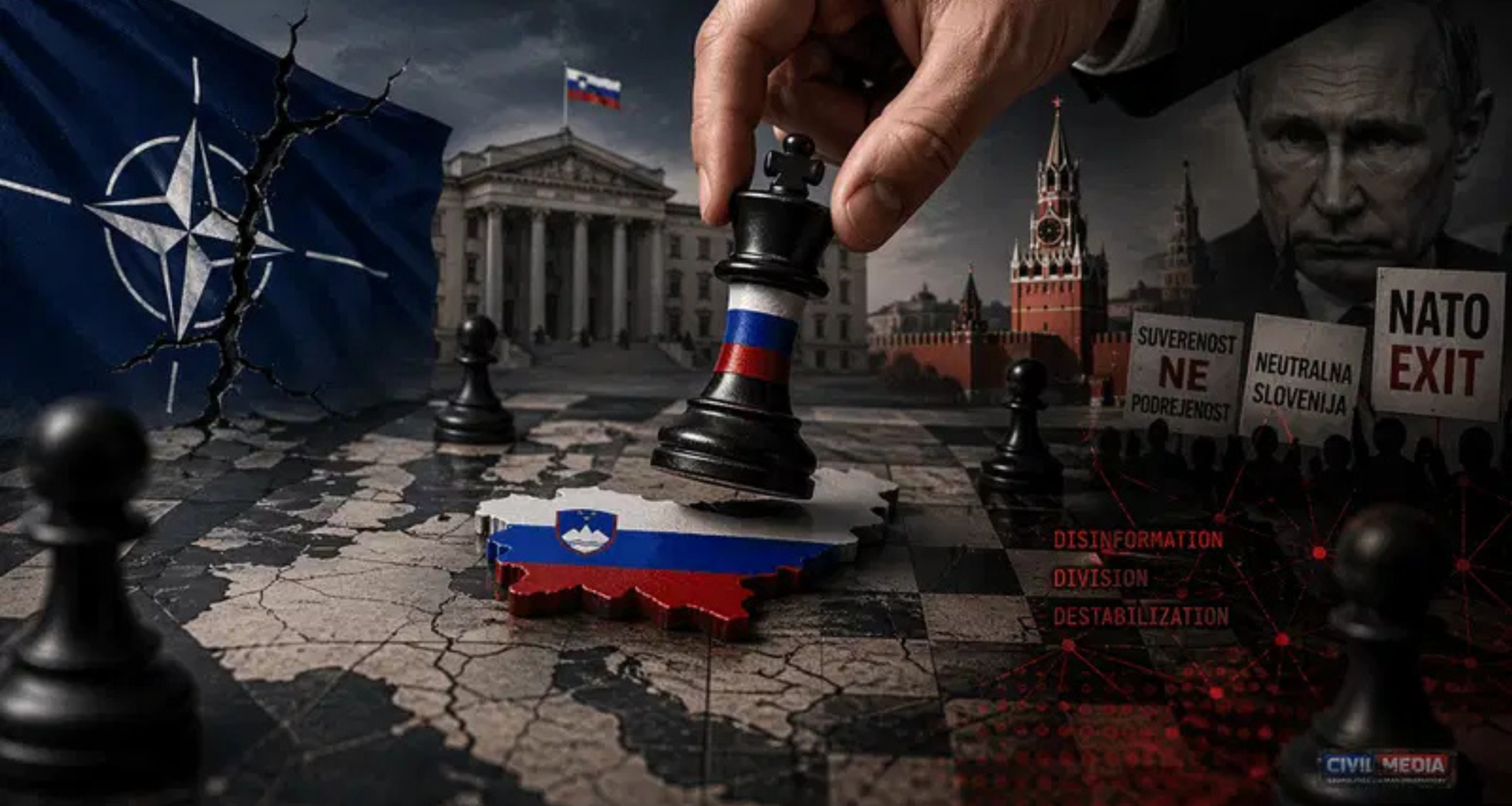
The first major signal of Zoran Stevanović as the new speaker of the Slovenian parliament was not a call for institutional stability, democratic restraint, or strategic clarity. It was something completely different. He called for a referendum on Slovenia’s withdrawal from NATO.
That matters far beyond Slovenia.
It is an attempt to reopen one of the most fundamental strategic choices of the Slovenian state at a moment when Europe is confronting the largest war of aggression on the continent since 1945 and a wider arc of instability stretching from Ukraine to the Middle East.
Slovenia has seen NATO membership put to a referendum before. It did so in 2003, when voters approved accession. And as recently as July 2025, Slovenian politics had already entered dangerous territory with an announced consultative referendum initiative related to NATO membership, later abrogated. It’s not the first time the issue has surfaced. But it may be the most dangerous version of it yet. The question is raised immediately after a close and polarizing election, from the office of the parliamentary speaker, in a post-election deadlock, and geopolitical strain. And while challenging the country’s strategic orientation toward NATO, he issued an announcement of a visit to Moscow. Golob’s bloc is moving into opposition after coalition talks failed, leaving Slovenia in a genuine post-election impasse. But even that scenario is less dangerous than legitimizing a national campaign around NATO withdrawal. This combination promises a perfect storm.
The danger lies not only in the referendum itself, but in the logic behind it. It has been established many times – the strategy of Vladimir Putin does not require tanks at every border. It thrives on fractures within democratic alliances, on the conversion of strategic commitments into domestic disputes, on turning security into spectacle and sovereignty into a slogan. In that sense, Stevanović’s line is perfectly aligned with Moscow’s interests whether or not direct coordination can be proven. His own public messaging – the referendum pledge, the language of sovereign non-alignment, the announced Moscow visit, and support for easing anti-Russian sanctions – places him squarely inside the wet dreams of the Kremlin.
Resni.ca’s record reinforces that concern. Public reporting has for some time pointed to strong links between the party and Russian actors. One of the clearest examples came in 2024, when 24ur reportedthat Bojan Potočnik, then a Resni.ca candidate for the European elections, warmly bid farewell to expelled Russian diplomat Sergei Lemeshev at the Russian embassy in Ljubljana. Lemeshev had been declared persona non grata by Slovenia for activities harmful to the country. Stevanović defended the closeness and called the expulsion a mistake. 24ur linked the affair to a broader pattern of Russian propaganda activity in the country. That episode does not by itself prove foreign control. But it does show that Resni.ca is not merely “anti-establishment” in the abstract, and it goes far beyond vague “sympathy.” It has long moved in a political environment where Russian state interests, local political grievances, and anti-Western narratives overlap.
Stevanović may deny being pro-Russian as much as he wants, but these positions align directly with long-standing Kremlin strategic goals: weakening NATO cohesion, normalizing sanctions fatigue, and turning alliance commitments into internal political conflict inside member states.
The Hungarian dimension should also be understood soberly. Direct, formal ties between Resni.ca and the political circle around Viktor Orbán are less clearly documented in public than the party’s ties to Russia. But the broader ecosystem is unmistakable. Hungarian-linked financing and media penetration in the sphere where Janez Janša is the top figure, have been documented for years, and that ecosystem has consistently served as an amplifier for sovereigntist, anti-liberal, anti-NGO, and pro-Kremlin narratives. In other words, even where the organizational lines are not fully visible, the strategic alignment is.
From the standpoint of democratic resilience, a political crisis caused by coalition deadlock is serious. But a referendum on NATO exit is worse. Deadlock produces uncertainty. A referendum on alliance withdrawal produces strategic vulnerability and exposure. Slovenia is about to spend months arguing not about how to govern, but about whether it belongs inside the security architecture that has underpinned its stability for more than two decades. It offers every hostile external actor a ready-made arena for manipulation. And it sends a message far beyond Ljubljana that – even in a stable and enthusiastic member state of both EU and NATO – the alliances can be turned into a political revisionist battlefield.
Democracies must not avoid difficult debates, but this question being asked now is not a neutral civic and democratic exercise. It’s a strategic opening. And if Slovenia becomes the place where this opening is normalized, others will study the precedent.
The risk is not only Slovenian. There is a domino logic here. Not automatic, not mechanical, but real. What is tested in Slovenia right now, through the messaging of a freshly appointed parliament speaker, will certainly be attempted elsewhere very soon.
For NATO, this will be precedent. A referendum campaign in one member state creates a live test case for how anti-alliance narratives can be mainstreamed from inside the Alliance itself. It shifts the question from “how to strengthen deterrence” to “whether membership itself is negotiable,” and that alone hands Moscow a strategic victory in the information space even before any vote took place.
For other NATO members, especially those with visible sovereigntist, pro-Russian, or anti-establishment currents, a Slovenian referendum campaign could become a template rather than an isolated event. Not necessarily an immediate chain reaction, but surely it will be politically contagious. If one member state can reopen the NATO question, others can try to instrumentalize the same issue for domestic mobilization, coalition bargaining, or anti-EU/NATO campaigning. That is why the main danger lies not only in a possible Slovenian outcome, but in the normalization of the question itself, shaped by an operation of influence and political manipulation rather than genuine democratic deliberation.
For the Western Balkans, the implications are even more serious. NATO has repeatedly stressed the region’s strategic importance and the inseparability of stability in Kosovo and the wider region from Euro-Atlantic security. A NATO exit referendum in Slovenia would be perceived as a weakening of Western cohesion at a moment marked by divisive rhetoric, identity disputes, unresolved status issues, and entrenched Russian influence. It would embolden anti-NATO and anti-EU actors in Serbia, encourage hedging elsewhere, and reinforce the perception that Euro-Atlantic integration is fragile and politically negotiable.
That matters because the Western Balkans do not experience NATO as an abstract alliance. Here, it is tied to deterrence, Kosovo’s security environment, Albania’s Euro-Atlantic anchoring, Montenegro’s strategic positioning, and the broader balance against Russian influence. This balance is already being strained by North Macedonia’s current nationalist government. A Slovenian campaign against NATO membership would therefore resonate far beyond its borders—signaling that the Alliance can be politically hollowed out from within, and that the language of sovereignty can reopen settled strategic choices.
Resni.ca’s denials should not distract from the record. The direct Russia links are already substantial: public defense of close contacts around an expelled Russian diplomat, rhetoric minimizing the problem of Russian influence, calls to revisit sanctions, and a push to reopen NATO membership itself. None of this has to be formally commanded from Moscow to serve Moscow’s objectives. In hybrid warfare, alignment is often more useful than control.
A potential referendum on NATO withdrawal is not simply a test for Slovenia’s foreign policy or democratic capacities. It is a test of the overall political immunity and cohesion of the Alliance itself. Even the campaign will be highly damaging, by creating strategic uncertainty, offering a permanent megaphone to hostile influence networks, and turning a member state’s security orientation into a battlefield of narratives.
And in the Western Balkans, this will resonate and expand. If Slovenia, an EU and NATO member, can be pushed into a public clash over alliance membership, then every fragile democracy, every captured media environment, and every pro-Kremlin political entrepreneur in the region will read the same lesson: pressure works, cohesion can be questioned and then fractured, and the Euro-Atlantic framework is open to attack from within.
And all this is actually happening. Slovenia may have fed the Kremlin’s narrative of pre-1997 NATO “borders,” triggering a new phase of Russia’s hybrid warfare in Europe with grave consequences.
© 2026 CIVIL – Center for Freedom | Licensed under CC BY 4.0
This article is part of the regional analytical series Western Balkans Stability and Democracy Outlook – 2026, implemented by CIVIL – Center for Freedom in cooperation with The Balkan Forum.
The views and analysis expressed in this article are solely those of the author and do not necessarily reflect the positions of The Balkan Forum.