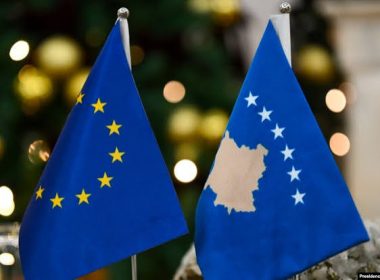

Ten years ago, the Stabilisation and Association Agreement between the EU and Kosovo came into force, meant to be the blueprint for bringing the country’s institutions and economy closer to Europe. In 2026, the European Commission’s latest report on Kosovo shows how unevenly that blueprint has been built. Read closely, it describes two Kosovos at once: one that can deliver serious economic and security reforms when it sets its mind to it, and another that keeps tripping over political deadlock and a justice system that moves too slowly, or not at all.
That contradiction is what anyone watching Kosovo, whether in government, in business, or in civil society, needs to take from this report. The story is neither steady progress nor outright failure. It is a patchwork. Where technical expertise and international support pull in the same direction, things move, and sometimes fast. But wherever reform demands real political consensus or institutions willing to be held accountable, the machinery stalls. In a few critical areas, it has started to slide backwards.
Where Kosovo is actually moving forward
It would be easy to read the Commission’s report as one long list of complaints, but that misses something. Kosovo has managed to push through real reforms in a few areas, and it did so while the political situation at home was a mess.
The Commission points to good progress on the free movement of capital, mostly thanks to a new Law on payment services and tougher legislation against money laundering and terrorist financing. Better information sharing and a stronger financial intelligence framework tell that the authorities want to close the gaps that illicit money flows through.
The business environment is improving too, in small steps. The Tax Administration set up specialized teams that use third-party data to catch what the informal economy hides, which is a practical way to widen the revenue base. Customs is probably the best story here. Kosovo finished moving to publicly operated customs terminals and dropped or cut the fees on consignments, as the Stabilisation and Association Agreement requires. Add pre-arrival clearance and higher revenue collection, and you get a system that’s faster and harder to cheat.
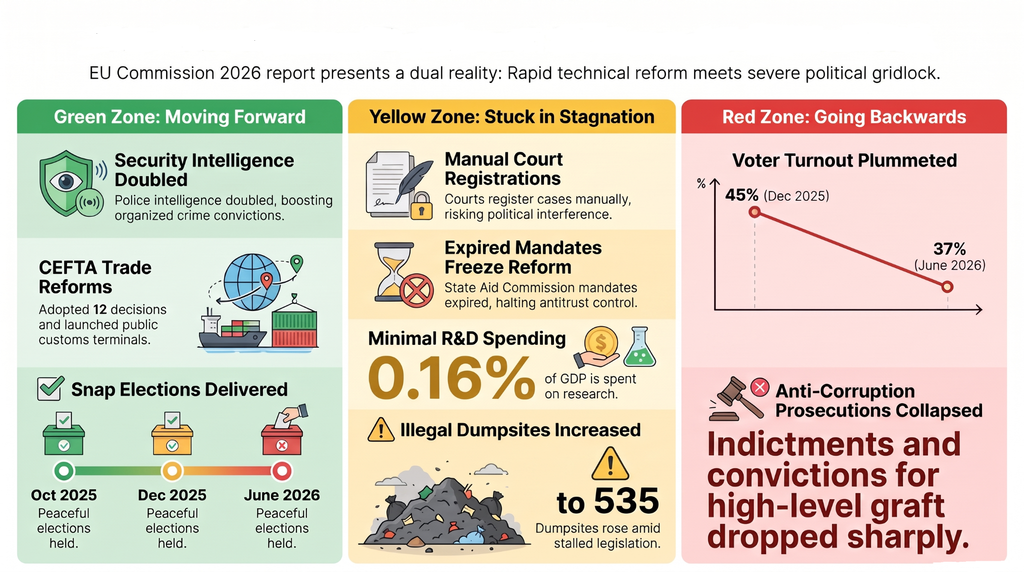
On security, the most interesting part is that the good results weren’t luck. Final convictions in organized crime cases went up substantially, and the likely reason is that the Kosovo Police doubled their intelligence structures, both centrally and in the regions. That gave them real analytical muscle and let them start investigations instead of just reacting. A task force aimed at loan sharking took apart several criminal networks and seized significant assets. A new confiscation fund means seized criminal property gets managed properly and put back into law enforcement. And cooperation with EU police forces is clearly working: requests and responses are flowing at high volume, with operational communications growing 25% a year.
Regionally, Kosovo’s CEFTA chairmanship turned out better than many might have expected. The Joint Committee adopted twelve decisions under its watch. Kosovo also ratified protocols on trade facilitation, trade in services and a regional dispute settlement mechanism, and adopted the Common Regional Market Action Plan 2025-2028.
Then there are the elections, which I’d call a quiet success. Kosovo held municipal elections in October 2025 and early parliamentary elections in December 2025 and June 2026, all on compressed timelines because of political instability. They were peaceful and competitive, and the administration handled them well. When disputes came up, the Election Complaints and Appeals Panel and the Supreme Court dealt with them effectively. For a country this politically stuck, that’s no small thing.
Where Kosovo is stuck
The economy and security sectors show what Kosovo can do. Much of the rest of its governance shows the opposite, a system that keeps doing what it has always done.
The judiciary is the most struggling case. The Commission reported no progress at all. Courts are still under undue influence, from inside the system and from outside political and economic interests, and that eats away at their independence and impartiality. The Case Management Information System technically works, but courts at every level still register cases by hand. That leaves plenty of room to decide which judge gets which case. Hearings drag on without achieving anything, sentences for similar crimes vary, and mandatory accessory punishments, like barring convicted people from public administration roles, aren’t applied systematically.
The same stagnation shows up in how the state manages money. Financial control got no upgrade, so public internal financial control is weak, and managers answering for their decisions is more idea than practice. Public investment management is no better. There’s no uniform way to appraise projects and no single, transparent pipeline, so capital projects tend to be badly planned, go over budget, and leave everyone guessing about their real socio-economic impact.
Then there’s the internal market, which Kosovo needs to work if it wants to integrate with Europe, and it’s frozen too. On free movement of goods, Kosovo hasn’t aligned its laws with EU standards on market surveillance, conformity assessment and metrology. Free movement of workers and competition policy didn’t move either. The State Aid Commission can’t function because its mandates expired, so state aid control and antitrust enforcement have effectively stopped.
The areas that matter most for a modern economy are stuck as well. Digital transformation and media policy went nowhere, held back by fragmented platforms, few online services, and no alignment with the European Electronic Communications Code. Science and research get just 0.16% of GDP, far below the EU average, and the Law on innovation and entrepreneurship is still a draft.
The green agenda may be the most worrying. Trans-European networks, environmental protection and climate change policy all saw no forward movement. Air pollution is a serious public health problem, and the waste management law still hasn’t been adopted. You can see the result on the ground: illegal dumpsites rose by nearly 17% to 535 in 2025. Agriculture is in the same position. Rural development and food safety made no progress, because the money and the inspection capacity just aren’t there.
Where Kosovo is going backwards
Stagnation at least means holding your ground. The 2026 report points to areas where Kosovo is losing ground.
The worst of it is high-level corruption. The record on prosecuting and judging elite graft got significantly worse. Final court decisions and convictions dropped sharply, and new indictments fell to almost a third of the previous year’s number. Whether that reflects an inability or an unwillingness to go after powerful people, the effect is the same: people have less reason to believe the rule of law applies to everyone.
That connects to a wider decline in democratic institutions, driven by political polarization that never let up. For much of the reporting period there was no functional Assembly, and government formation dragged on. The government spent most of that time in caretaker mode, which meant it couldn’t carry out structural reforms even if it wanted to.
When parliament did work, it didn’t work well. Lawmaking became unpredictable and leaned on fast-track procedures that skipped proper consultation with stakeholders and civil society. Boycotts of sessions and a complete lack of cooperation between the ruling coalition and the opposition weakened oversight and broke down checks and balances. Leadership posts at important independent regulatory institutions went unfilled.
Ordinary people have noticed. The election machinery worked fine, but voters were losing interest. Gridlock and constant snap elections wore them out, and it showed at the polls: turnout fell from 45% in December 2025 to 37% in the June 2026 parliamentary elections. The campaign environment didn’t help either. Gaps in campaign finance transparency were left unaddressed, public resources were misused, and digital disinformation and hate speech spread unchecked, so the playing field was never level.
Women in Kosovo’s politics: the quota worked, but only up to a point
Political stagnation and deeper social barriers meet most visibly in who actually holds power, and the 2026 figures on women’s political participation show a picture that is encouraging in one place and badly lopsided in another.
Start with what went right. Kosovo has a strict legal quota requiring 30% women on candidate lists, and it has done its job. After the June 2026 elections, women hold 34.2% of Assembly seats, which puts Kosovo roughly level with the EU average. Women also landed some of the top jobs in parliament: the Assembly Speaker is a woman, and women chair seven of the sixteen parliamentary committees.
Table 1. Political Position and Women in Kosovo
| Political Position | Total Positions | Number of Women | National Percentage | EU-27 Average |
| Members of Parliament (MPs) | 120 | 41 | 34.2% | 34.9% |
| Ministers | 19 | 5 | 26.3% | 32.1% |
| Party Leaders | 52 | 4 | 7.7% | 25.6% |
| Mayors | 38 | 1 | 2.6% | 34.9% |
But a quota only guarantees a place on the list. It says nothing about who ends up running things. Analyzing the executive and at local government, where political power is actually exercised, and the parity looks a lot thinner. That’s the drop-off the Commission’s findings reveal, and the table above shows how steep it gets at the top. The numbers say a lot. Women can win seats in parliament, but the higher you go, the fewer of them you find. Only 5 of the 19 ministerial portfolios are held by women. At the top of party politics it gets worse: women lead just 7.7% of political parties, while the EU average is 25.6%.
Local government is where the gap is widest. Kosovo has 38 municipalities, and exactly one has a woman as mayor. That is 2.6%, against an EU average of 34.9%. Voters didn’t cause this. Women made up only about 10% of mayoral candidates, so most of them never reached the ballot. The Commission says female candidates are starved of campaign money and public visibility. It also reports that violence against women in politics, mostly vicious hate speech and discriminatory language aimed at them, showed up in all three recent election cycles. Add patriarchal norms and financial marginalization, and the glass ceiling is still firmly in place, whatever the parliamentary quota suggests.
What’s next for the region?
The message is simple for the Western Balkans Countries: countries that keep reforming get closer to membership, and the others fall behind.
Montenegro is out in front. The Commission says it has met all closing benchmarks, and an accession treaty could be drafted by spring 2027, with membership possible by 2028. Albania is about a year behind and could reach Montenegro’s current stage by the end of 2027. Its judicial vetting is complete at the appeal phase and SPAK is delivering results, and the economy is strong, with the current account deficit at historic lows. But the parliament is stuck in clashes between majority and opposition, and the country saw its largest civic mobilization since the transition, with protests turning violent by October 2026. Serbia is technically ready to open Cluster 3, still broader problems complicate its path. North Macedonia made no progress on the required constitutional changes. Bosnia and Herzegovina is the most worrying case: it is drifting away from the EU path, has not adopted key judicial reform laws or named a chief negotiator, and that puts millions of euros in Growth Plan funding at risk. However, alongside Kosovo’s progress and ongoing challenges, it is crucial to analyze how much of this progress is translating into real integration, and whether the EU itself is remaining consistent in maintaining a clear European perspective.

Arta Haxhixhemajli
Research Officer at The Balkan Forum