


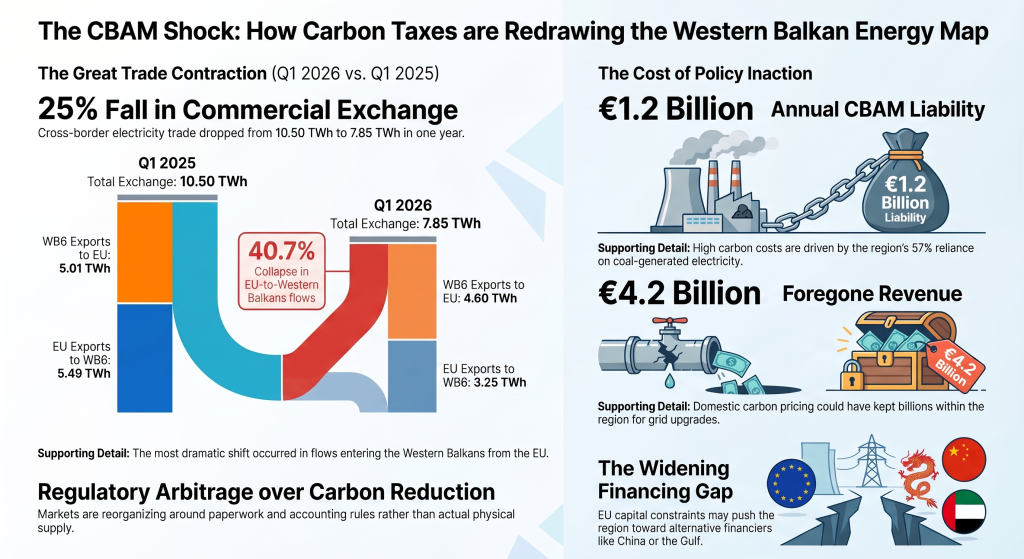
In the first quarter of 2026, something unusual happened to the flow of electricity between the European Union and the Western Balkans. It showed up not as a blackout or a price spike, but as a statistic: commercially scheduled cross-border electricity exchange between the EU and its Western Balkan neighbors fell by roughly 25 percent compared to the same quarter in 2025, from a combined 10.50 TWh in Q1 2025 to 7.85 TWh in Q1 2026, even as the physical wires carrying that power stayed just as busy. That gap, between what the market says is happening and what the grid actually does, is the clearest early signature of the EU’s Carbon Border Adjustment Mechanism (CBAM) reshaping a regional energy relationship built over two decades.
What the Q1 Data Actually Shows
CBAM entered its financial phase on 1 January 2026, requiring EU importers of electricity, steel, cement, aluminum, fertilizer, and hydrogen from outside the bloc to pay for the embedded carbon in what they bring in. For the Western Balkans, where a majority of imported electricity is still coal-based, that mechanism landed squarely on the region’s most EU-integrated export sector.
The Energy Community Secretariat’s own Q1 2026 monitoring report is unusually candid about what happened next. Commercially scheduled exchanges across the EU-WB6 border contracted by around 25 percent, driven overwhelmingly by a collapse in EU-to-Western Balkans flows rather than any change in the region’s own exports: flows from the WB6 into the EU dipped a modest 8.1 percent, from 5.01 TWh in Q1 2025 to 4.60 TWh in Q1 2026, while flows from the EU into the Western Balkans collapsed by 40.7 percent, from 5.49 TWh to 3.25 TWh over the same period. At the same time, day-ahead electricity prices in the Western Balkans averaged about €30 per megawatt-hour below neighboring EU markets, a gap two to three times wider than the same period a year earlier. Ordinarily, a price gap that size would pull traders toward arbitrage, buying cheap in the Balkans and selling into the pricier EU market. Instead, trade shrank. The CBAM charge on carbon-intensive exports ate the arbitrage margin before it reached anyone’s balance sheet.
More telling still, the report documents a widening divergence between what traders scheduled commercially and what electrons actually did on the wires, particularly on the Albania-Greece route, where scheduled exports rose without a matching increase in physical flow. Power continued moving along the grid’s physical logic instead, from Albania toward Montenegro and Bosnia and Herzegovina and onward to Croatia, Hungary, and Romania. That’s a market quietly reorganizing itself around a carbon border rather than around supply and demand, which is precisely the kind of distortion the region’s transmission operators are now flagging as a risk to grid predictability.
The Liability Nobody Priced In Early Enough
The scale of exposure here isn’t trivial. The Energy Community Secretariat has put the region’s CBAM liability at almost €1.2 billion annually, a figure driven by the roughly 57 percent of EU-bound electricity from Bosnia and Herzegovina, Montenegro, North Macedonia, and Serbia that is coal-generated. That figure represents a major annual carbon-cost exposure for the region, much of which might otherwise have been captured through domestic carbon pricing and recycled into transition investment.
That’s not an accident of timing so much as a policy choice deferred. All six governments signed onto the 2020 Sofia Declaration and the Energy Community’s 2021 Decarbonisation Roadmap, both committing them to introduce carbon pricing well ahead of CBAM’s 2026 start date. Only Montenegro followed through, launching an emissions trading system in 2020 that now covers its Pljevlja coal plant, the KAP aluminum smelter, and a steel mill. The other five governments, several of which oversee politically influential state-owned utilities that remain major employers, did not.
The foregone revenue is the sharper part of the story. CEE Bankwatch modeling from 2022 estimated that a moderate domestic carbon price of €50 per tonne could have raised the WB6 governments roughly €2.8 billion a year collectively, revenue that could have funded exactly the kind of grid upgrades and just-transition programs the region now needs and doesn’t have money for. Bankwatch’s updated 2025 analysis pushes that figure as high as €4.2 billion annually under current carbon-price assumptions. Either estimate points to the same structural problem: domestic carbon pricing could have retained substantially more transition revenue within the region, while CBAM now exposes exporters to carbon costs whose economic incidence can fall partly on Western Balkan producers through lower margins, reduced demand, and weaker competitiveness.
Arbitrage, Not Convergence
The most consequential finding buried in the Q1 data is that CBAM rewards origin certainty over actual emissions performance, not carbon reduction itself. Albania’s hydropower-dominated grid carries a default emission factor of zero under CBAM’s accounting rules, so its exports continue largely unaffected. Montenegro’s exports, by contrast, are penalized under the same methodology even when the underlying generation mix is comparable, because the accounting relies on a trailing average carbon intensity for each exporting system rather than tracing individual megawatt-hours to their actual source.
The result is a two-tier market where commercial routing decisions increasingly depend on whose paperwork looks cleanest, not on where the electrons are lowest-carbon or cheapest to deliver. That’s the regulatory arbitrage in this piece’s title: trading desks are adapting to CBAM’s accounting quirks faster than the region’s governments are adapting to its substance.
The External Financing Question
The macroeconomic squeeze this creates, a shrinking export market, a widening price gap that can’t be monetized, and substantial annual carbon-cost exposure that might otherwise have supported transition at home, raises an uncomfortable question: who finances the Western Balkans’ energy future if EU-aligned capital doesn’t move fast enough to fill the gap?
China’s role here is more complicated than a simple substitution story. A decade ago, Chinese state-owned enterprises and policy banks were the default financiers of new Balkan coal capacity, building Bosnia’s Stanari plant and Serbia’s Kostolac B3 unit. Since Beijing’s 2021 commitment to stop financing overseas coal, that model has shifted toward renewables, though unevenly. Chinese firms are now involved in wind, solar, and storage projects across Bosnia and Herzegovina and Serbia in particular, sometimes as financiers, sometimes as equipment suppliers, sometimes simply as the winning bidder on EU-financed contracts. Montenegro and Kosovo have seen little comparable Chinese involvement so far, suggesting the pattern reflects each government’s own procurement choices as much as any coordinated strategy from Beijing.
Still, the structural incentive is real. A region facing a widening financing gap, thin domestic carbon-pricing capacity, and a coal-dependent utility sector that European lenders are increasingly reluctant to underwrite is a region where alternative capital, whether Chinese, Gulf, or otherwise, has an easier opening than it would in a well-capitalized market. CBAM was designed to price carbon at the EU’s border. Its unintended second effect may be to compound the financing constraints already limiting European support for the Western Balkans’ transition, at exactly the moment non-EU lenders are able to offer speed and flexibility that EU-aligned institutions, bound by their own climate conditionality, increasingly can’t match.
None of this is irreversible. The Energy Community Secretariat frames Q1 2026 as a baseline, not a verdict, cautioning that a single quarter shaped by exceptional hydropower conditions shouldn’t be read as proof of permanent structural change. But the direction of travel, a shrinking commercially scheduled market, a widening price gap nobody can arbitrage, and substantial annual carbon-cost exposure that could otherwise have been partly captured through domestic carbon pricing, is not one that resolves itself. It resolves through domestic carbon pricing, market coupling with the EU, or continued drift toward whichever external financier moves fastest. The Western Balkans have spent the better part of a decade treating that choice as one they could defer. CBAM has just made deferral its own kind of decision.
Sources
- Energy Community Secretariat, “New Report shows profound electricity market changes in South East Europe as CBAM takes effect,” April 2026. energy-community.org
- Balkan Green Energy News, “CBAM data for Q1 2026: Historic power flow patterns between EU, Western Balkans shift,” June 2026. balkangreenenergynews.com
- CEE Bankwatch Network, “CBAM: Western Balkan governments must act now to avoid ‘perfect storm,'” October 2025. bankwatch.org
- CEE Bankwatch Network, “The Western Balkan Power Sector: Between Crisis and Transition,” December 2022. bankwatch.org
- “Diversifying energy, concentrating risk? China and the Western Balkans’ green transition,” China in the Western Balkans, August 2026. chinainthewesternbalkans.substack.com

Benjamin Jenkins Wise
Political Science Graduate and UNCTAD Intern