

A debate in Washington over KFOR troop levels exposes a deeper strategic reality: Kosovo remains the geopolitical fulcrum where Serbia’s ambitions, Russian hybrid operations, and Western deterrence collide.
By Xhabir Deralla, CIVIL Today
Not knowing something is sometimes ignorance. But when facts are readily available and still ignored, it becomes something else — arrogance.
When a considerable number of U.S. lawmakers sign a letter to the Secretary of State, Marco Rubio, in which they claim that there are “continued actions by Kosovo’s central government that continue to aggravate communities,” the problem is not merely a lack of information. It risks sounding like something far worse.
These are U.S. lawmakers, after all. They are not anonymous commentators or political influencers navigating social media noise. With entire teams of advisors, analysts, and diplomatic channels at their disposal, they are expected to be factual, precise, and responsible — particularly when addressing one of the most sensitive geopolitical regions in Europe.
Their appeal is directed to one of the most influential figures in American foreign policy, a member of the crème de la crème of U.S. political power. And it concerns a very real and serious development in the ever-neuralgic Western Balkans: the possibility of reducing the U.S. military presence in the NATO-led mission Kosovo Force (KFOR).
The concern behind the letter is legitimate. The Western Balkans remain fragile, and Kosovo sits at the centre of a delicate security architecture that has preserved peace since 1999. In that sense, the letter deserves attention.
But the wording matters.
By suggesting that Kosovo’s central government is aggravating communities without properly contextualizing the situation — including the constant pressure, destabilization efforts, and political manipulation emanating from Serbia — the letter risks reinforcing misleading narratives that have long been weaponized in regional propaganda.
That does not mean Kosovo’s government should be shielded from criticism. Far from it. Kosovo, the youngest state in Europe, is navigating recurring political crises and governance challenges — many of them driven by its own political leadership and competing actors within the country. But criticism must be grounded in facts and context, particularly when it comes from actors whose words carry strategic weight.
Because in the Western Balkans, even well-intended political statements can have unintended consequences. Attempts to resolve one problem often create the conditions for another.
And when signals come from Washington, they rarely remain mere words. In a region shaped by unresolved conflicts, nationalist agendas, and persistent hybrid influence operations, they can easily become sparks.
Beyond this problematic formulation, the letter raises a far more important and urgent strategic issue. Here is what it is about:
A bipartisan group of members of the U.S. Congress has warned the State Department about the potential consequences of reducing American troops in the NATO-led peacekeeping mission Kosovo Force (KFOR). In a letter sent on March 11 to Marco Rubio, lawmakers caution that even a limited reduction of the U.S. military presence could destabilize the Western Balkans and weaken deterrence in one of Europe’s most fragile geopolitical regions. Some may argue that a reduction — not a withdrawal — is not a cause for alarm. Yet this is exactly where the lawmakers raise a valid and important point.
The lawmakers emphasize that the U.S. contribution to KFOR may be relatively small in numbers, but strategically decisive.
“The United States provides up to 500 military personnel… a small presence with an outsized impact.”
They describe the American role as the backbone of KFOR’s deterrence, warning that reducing that presence could weaken both the operational capacity and the political credibility of the mission.
As the letter states:
“Any reduction of U.S. military personnel could have considerable implications not just for the operational capabilities of the peacekeeping force but weaken the role of KFOR as a political deterrent in maintaining peace and stability in Kosovo.”
This warning should not be treated as routine bureaucratic caution. It reflects a growing recognition in Washington that the Western Balkans remain vulnerable to destabilization and that signals of reduced Western engagement could trigger wider consequences.
Kosovo: A Geopolitical Fulcrum
Kosovo has been central to the post-1999 security architecture in the Western Balkans. The presence of NATO forces has prevented renewed escalation between Kosovo and Serbia and has served as a stabilizing force across the wider region. At the same time, Kosovo is also the place where competing geopolitical strategies collide.
Serbia’s current leadership, backed by Russia, continues to apply pressure through a combination of diplomatic obstruction, military signalling, and relentless nationalist rhetoric surrounding Kosovo. Periodic troop deployments near the border and inflammatory political messaging are accompanied by direct support for destabilizing actions — such as the 2023 terrorist attack in Banjska in 2023 and the sabotage of energy and water supply infrastructure in 2024. The mobilization of nationalist networks further reinforces the message that Belgrade has not abandoned its political ambitions toward Kosovo.
These dynamics increasingly align with broader destabilization efforts linked to Russia and its hybrid operations across Europe.
This is where Serbia’s hegemonistic project and Moscow’s shadow become impossible to ignore.
In the analysis “The Serbian World and Moscow’s Hand in the Balkans,” published in October 2025, we at CIVIL described how the concept of the so-called “Serbian World” functions as a framework for projecting political and cultural influence across borders in the region. The project mirrors the Kremlin’s geopolitical doctrine of the “Russian World,” in which identity narratives are used to justify influence and intervention beyond national borders.
What makes this development particularly concerning is that the idea of the “Serbian World” is not merely cultural rhetoric but a political strategy increasingly aligned with Moscow’s broader geopolitical agenda — one that thrives on instability, insecurity, and political paralysis across the region.
This alignment has become more visible since Russia’s full-scale invasion of Ukraine. While Serbia formally maintains military neutrality — and even sells ammunition to the United States that ultimately ends up in Ukraine — its political messaging, media environment, and diplomatic positioning frequently echo narratives that benefit the Kremlin, contaminating the regional information space through aggressive propaganda operations.
Kosovo, in this context, becomes more than a bilateral dispute. It becomes a strategic pressure point where regional nationalism and global geopolitical competition intersect.
Early warning signals visible for a long time
The warning from U.S. lawmakers also confirms concerns that analysts in the region have been raising for years.
In the analysis “Russian propaganda narratives are persistent and on the rise — democratic forces remain fragmented and hesitant,” published on CIVIL Today on February 4, 2026, I warned that the information space in Europe and the Western Balkans is increasingly shaped by coordinated propaganda ecosystems.
“Russian propaganda narratives continue to expand across platforms and regions, while democratic societies still fail to protect themselves effectively against long-term information manipulation and psychological operations,” the early warning report concluded, prepared by CIVIL’s Hybrid Threats Monitoring Team (CHTM).
One of the central narratives identified by CHTM originates from the Moscow–Belgrade propaganda apparatus, portraying NATO as an external force threatening national sovereignty.
The strategic objective of this narrative is to weaken public support for NATO and gradually normalize geopolitical disengagement from Western institutions.
As repeatedly reported in CIVIL’s analyses, this propaganda line rarely calls openly for withdrawal from NATO. Instead, it promotes “neutrality” as a supposedly safer and more dignified alternative.
Such narratives resonate strongly in the Western Balkans, where unresolved historical grievances and identity politics remain powerful mobilizing tools.
Hybrid Warfare Operations and the Logic of Deterrence
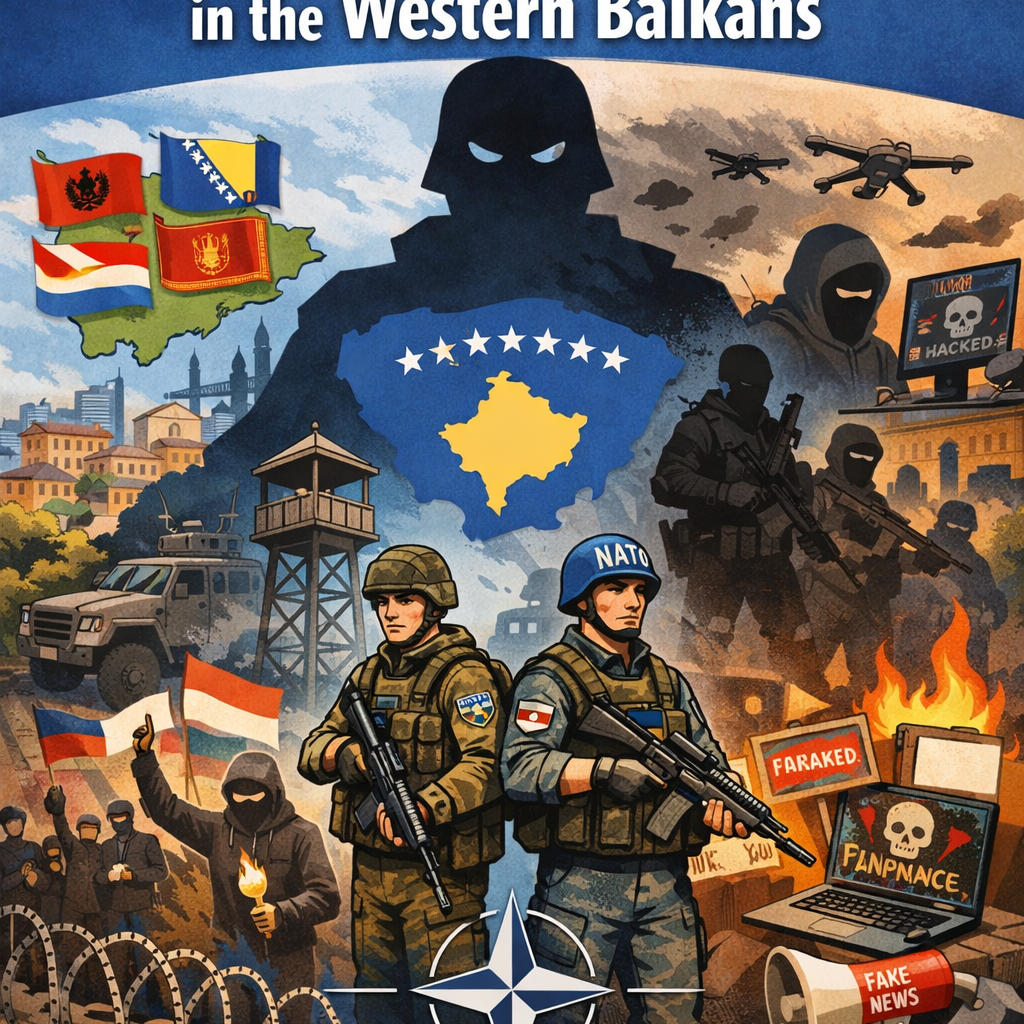
The broader strategic context was already outlined in CIVIL’s early-warning report “The Fracture Line: Russia’s Hybrid Strategy in the Western Balkans,” published in November 2025. The report warned that the region has increasingly become a testing ground for hybrid influence operations that combine propaganda, political pressure, economic leverage, and identity mobilization.
As the report concluded:
“Russia’s strategy in the Western Balkans is no longer driven by territorial ambition but by a sophisticated hybrid campaign that exploits the region’s unresolved histories, fragile institutions, and deep identity divisions.”
The objective of this strategy is not necessarily open conflict but the maintenance of a persistent state of instability that weakens democratic institutions and obstructs Euro-Atlantic integration.
In such an environment, even seemingly technical decisions — such as troop deployments — carry strong symbolic and strategic significance.
The strategic logic behind regional security cooperation was something I addressed nearly a year ago in my analysis “New alliances in a divided region: Confronting the Kremlin’s aggression and the Balkans’ old ghosts,” published in April 2025.
“Security is not a provocation. Deterrence is not escalation,” I wrote. This wasn’t too difficult to comprehend at any point of time.
That argument remains valid today. Stability in the Western Balkans cannot rely on wishful thinking or passive diplomacy. It requires credible deterrence, strategic coordination among democratic partners, and a clear commitment to the region’s security architecture. The NATO mission in Kosovo remains one of the key pillars of that architecture.
In security policy, signals often matter as much as numbers. A reduction of several hundred troops may appear modest in purely military terms. But in a region marked by unresolved conflicts, nationalist mobilization, and persistent hybrid influence operations, such signals carry enormous political weight.
The Western Balkans remain one of Europe’s most sensitive geopolitical fault lines. Any perception of weakening international commitment can quickly embolden actors who view instability as an opportunity.
The warning from members of the U.S. Congress suggests that policymakers in Washington understand the risks. The question is whether the wider political system will recognize that maintaining stability in the Western Balkans requires not hesitation, but clarity and resolve.
A Warning That Deserves Serious Attention
If the many warnings from analysts have not yet succeeded in awakening the powerful decision-making structures across the world, the letter sent by members of the U.S. Congress to Secretary of State Marco Rubio should. It should certainly not be dismissed as a routine procedural intervention in Washington’s foreign policy debates. Rather, it reflects a deeper concern about the stability of the Western Balkans and the potential consequences of weakening the security architecture that preserves peace in the region.
The lawmakers are right to warn that even a limited reduction of American troops within the NATO-led Kosovo Force (KFOR) could have implications far beyond the number of soldiers involved. In regions marked by unfinished history and unresolved conflicts, aggressive nationalist mobilization and authoritarian tendencies, and persistent Russian hybrid operations, security signals carry strategic weight.
Kosovo sits at the centre of that fragile balance.
For more than two decades, the presence of NATO forces in Kosovo has served not only as a peacekeeping mission but also as a political and strategic deterrent against escalation between Belgrade and Pristina. It has also functioned as a stabilizing anchor for the wider Western Balkans, where fragile institutions, unresolved historical grievances, and geopolitical competition continue to intersect — including through its strategic supporting role to EUFOR Althea forces in Bosnia and Herzegovina.
But the region today is not the region of 2004, or even 2014. Russia’s full-scale invasion of Ukraine in 2022 has reshaped Europe’s security environment in ways that will likely define the continent’s geopolitical reality for years, perhaps decades. Hybrid warfare has become a central instrument of geopolitical competition, and the Western Balkans remain both a frontline and one of the most vulnerable arenas where these strategies are tested.
Serbia’s hegemonistic ambitions, framed through the ideological concept of the “Serbian World” — mirroring the Kremlin’s doctrine of the “Russian World” — continue to operate in parallel with Russia’s broader effort to undermine Euro-Atlantic structures. Political pressure on Kosovo, destabilization efforts in Bosnia and Herzegovina, identity manipulation in Montenegro, and aggressive propaganda operations accompanied by democratic backsliding in North Macedonia and elsewhere in the region, extending even into Central Europe, all form part of a wider system of influence.
Within that system, Kosovo functions as a geopolitical fulcrum — or potentially as an igniting fuse.
This is why the warning from members of the U.S. Congress deserves serious attention, even if parts of their letter contain problematic formulations that risk misinterpreting the dynamics on the ground. The core concern behind their message remains valid: weakening deterrence in Kosovo could trigger consequences that extend far beyond the territory itself.
History in the Western Balkans shows that instability rarely remains contained.
A perceived reduction of Western commitment — even if technically limited — can quickly embolden actors who view crises not as risks but as opportunities. And in a region where propaganda narratives constantly portray NATO as weakening and the West as retreating, even symbolic signals can rapidly acquire strategic meaning.
That is why the debate triggered by the congressional letter should not revolve solely around troop numbers. It should focus on the broader question of whether the international community — and particularly the United States — is prepared to maintain the clarity and resolve required to preserve stability in one of Europe’s most sensitive geopolitical fault lines.
The Western Balkans have long served as a laboratory for hybrid warfare and geopolitical pressure.
And if deterrence weakens there, the consequences will not remain local.
They will travel.
This article is part of the regional analytical series Western Balkans Stability and Democracy Outlook – 2026, implemented by CIVIL – Center for Freedom in cooperation with The Balkan Forum.
The views and analysis expressed in this article are solely those of the author and do not necessarily reflect the positions of The Balkan Forum.
Digital tools and AI assistance were used in the preparation of this analysis.

Xhabir Deralla