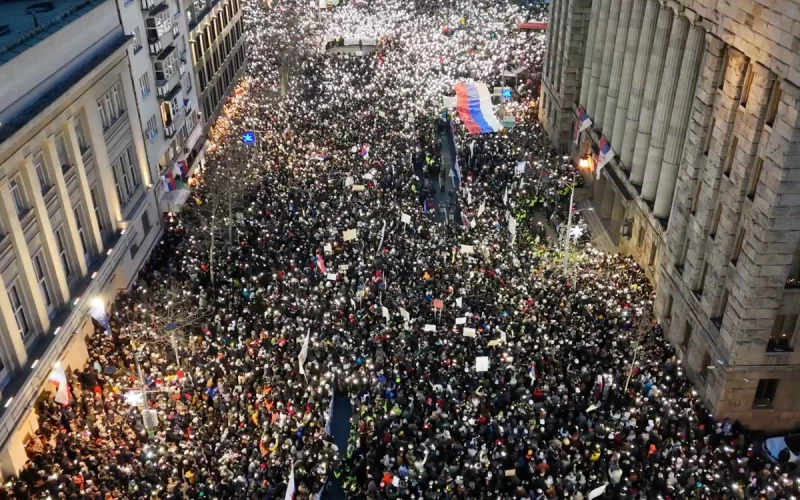


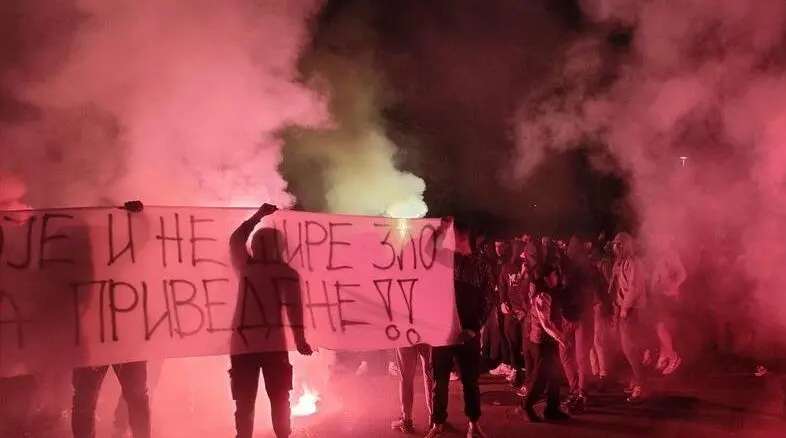
The events in Montenegro were not the result of a sudden outburst of rage, but rather the evolution of a familiar pattern under particular conditions. A solitary street event in Podgorica was the main reason for the wider opposition against Turkish people, revealing the extent to which fear can be organized quickly when society is already prepared to accept it. By gathering peaceful slogans turned to violent ones, destruction of property took place, and some had to defend not because they were in the wrong but because they were seen as ‘wrong’ people. The violence didn’t increase for no reason.
Online, a lot of misleading narratives and exaggerated stories had been told, and these were mainly responsible for the view that the Turkish community was very big and powerful, and to some extent, the government came to this conclusion because people just could not separate fact from fiction anymore as the narrative had been so widely publicized. Once the situation finally blew up these narratives gave the authorities both a reason and a scapegoat. In the end, the government took the route of launching investigations and restoring order, while the authorities announced figures that disputed the claims that had caused the public to panic. However, certain policy measures like restricting visa-free travel gave a hint of how fast fear can influence the making of decisions that would have serious diplomatic and economic consequences.
The government’s action was to end the long-standing visa-free travel for Turkish nationals and they thought it was a panic reaction rather than a wise decision. The leaders justified the action as a security measure, while the critics branded it a political reflex that might even exacerbate the already-existing divisions and stigmatize the entire community for the few misdeeds. The most worrying factor in this case is the rapid shift in public discussion from violence to collective blame. These types of reactions not only cause Montenegro to lose diplomatic and economic relations with Turkey, a very important partner but also reinforce the idea that the nationality of the attackers is the same as their crime.
A temporary suspension was decided as a measure to calm the public’s unrest after a Podgorica incident, which was termed as Turkish by the local media; thus, a quick government response was required. However, the court afterward pronounced that the detainees were not related to the incident thus eliminating the legal basis for linking the entire Turkish community with the case.
The suspension resulted in a chain of immediate practical effects: there was a huge influx of visa applications at the Turkish diplomatic missions and changes in the operations of some airlines flying between Montenegro and Türkiye. The act led to a series of immediate practical consequences: the Turkish diplomatic missions received a large number of visa applications, and some airlines flying between Montenegro and Türkiye made changes to their operations. However, the very goal of re-establishing visa-free travel is to ease the situation and to portray the two countries as having always been very friendly. The expected reversal is a sign of diplomatic communication and a search for a good compromise between security concerns on one side and the economic and social ties on the other side, with tourism and bilateral cooperation being so crucial.
The very aim of reinstating visa-free travel is to smooth up the situation and to show that the two nations have always been very friendly to each other. The anticipated reversal is indicative of diplomatic interaction and a quest to strike a healthy balance between security worries on one hand and economic and social ties on the other, especially considering the vital role of tourism and bilateral cooperation.
This is not only a crisis management blunder but also reveals a political culture that too frequently equates noise with power and draws the line between the nationalities of the innocent and the guilty. The authorities’ handling of the crisis not only failed to clarify the distinction between individual and collective identity but actually escalated the panic that they were supposed to calm down. The xenophobic slogans were very much present, businesses were treated differently just based on their origin, and even the simple food delivery choice was altered by anxiety-driven preferences.
The irony is very clear in this case: the leaders, while trying to be strict, let the most intolerant and loudest voices dominate the dialogue. Eventually, hate and fear will not be tolerated in the ruling; consistent leadership that transforms hate into civic virtues being the source of long-term peace. The region which has suffered through long-standing historic conflicts is in dire need of clarity at this moment.

Arta Haxhixhemajli
Researcher at The Balkan Forum